
Guides/Theory test
Irish Road Terms Explained: The Words the Theory Test Assumes You Know
Updated 15 September 2026 · 8 min read
The theory test is written in the language of the Rules of the Road, and some of that language is not how anyone talks. A question about a "courtesy pedestrian crossing" or a "humpbacked hill" is easy once you know what the phrase means and impossible if you do not. This page defines each term in one paragraph, gives the rule that goes with it, and points to the question that uses it.
Auxiliary lane
An extra lane to the left of the main motorway lanes that links one junction to the next. If you are in lane 1 and intend to take the next exit, you move into the auxiliary lane to leave. It is marked by a broken white line with shorter, closer, wider dashes than the normal lane lines. It is not a hard shoulder and not an overtaking lane.
Auxiliary lane in full
Where you meet them, when to move in, and the exact theory test question.
Read the auxiliary lane guide2-plus-1 road
A road with two lanes in one direction and one in the other, separated by a barrier, with the two-lane side swapping roughly every 2 kilometres. You overtake only in the two-lane (plain) section, never across the barrier. Built on busy national roads to remove head-on overtaking.
2-plus-1 roads in full
The layout, where overtaking is allowed and both theory test questions.
Read the 2-plus-1 road guideClearway
An area of road that must be kept clear for moving traffic during the times on the plate, usually rush hour. No stopping and no parking while it is in force, not even to drop someone off. Sign: a red circle with a red cross on a white ground and a times plate underneath.
Clearways in full
The sign, how it differs from no-parking, and the theory test questions.
Read the clearway guideContra-flow bus lane
A bus lane running in the opposite direction to the traffic beside it, usually on a one-way street. Only buses on a scheduled service may use it, at all times, and you may never stop or park in one. A with-flow bus lane, by contrast, runs with the traffic and admits taxis and cyclists during its hours.
Contra-flow bus lanes in full
The sign, the with-flow comparison and the three theory test questions.
Read the contra-flow bus lane guideHumpbacked hill and humpbacked bridge
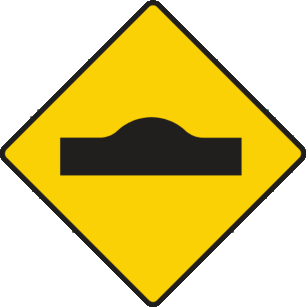
A hill or bridge that rises sharply enough that you cannot see the road on the far side until you are on the crest. The danger is what you cannot see: a vehicle overtaking towards you, a stopped car, a cyclist. Approach expecting a hidden hazard, slow down, keep left, and never overtake or park on the brow. Parking on the brow of a hill or on a humpbacked bridge is prohibited because it hides you from drivers coming up the other side and forces them into oncoming traffic.
- Slippery road: slow down gently on the approach, select the right gear for your speed, steer and accelerate gently.
- Towing: a low tow hitch can strike the road on the crest and detach the trailer. Check ground clearance before the journey.
- Theory test: "What should the driver do when approaching a humpbacked hill?" Answer: be aware of hidden dangers ahead and be prepared to react.
Courtesy pedestrian crossing
An uncontrolled crossing place: a spot laid out for pedestrians to cross, often with a dropped kerb, tactile paving or a raised table, but with no lights, no zebra stripes and no legal obligation on drivers to stop. Pedestrians should only step out when they are sure traffic has seen them. Drivers should slow right down on the approach and expect people to be crossing. The theory test answer to "What is a courtesy pedestrian crossing?" is "an uncontrolled pedestrian crossing place", not a crossing with flashing amber lights (that is a zebra) or one on a pedestrian street.
Rear fog lights
The high-intensity red lights at the back of the car, switched separately from the ordinary tail lights. You must only use them in dense fog or falling snow. In normal conditions they dazzle following drivers and make your brake lights harder to see, which is why leaving them on after the fog lifts is a fault. In dense fog the right set-up is dipped headlights with front and rear fog lights, never main beam.
Hard shoulder
The strip to the left of the main lane, marked by a broken yellow line on national roads. On a national road it is for pedestrians and cyclists, and you may pull in briefly to let a vehicle behind overtake if it is clear and there are no junctions or entrances nearby. On a motorway you must not drive on the hard shoulder except in an emergency.
Plain section
The theory test’s name for the two-lane stretch of a 2-plus-1 road, the part where overtaking is allowed. It comes round roughly every 2 kilometres in each direction.
Brow of a hill
The crest, the highest point where the road ahead disappears from view. No overtaking and no parking on or near it. Same reasoning as the humpbacked hill: anything on the far side is hidden until it is too late.
Box junction
A junction with yellow criss-cross lines painted on the road. You may not enter the box unless your exit is clear, with one exception: you may wait in the box when turning right, if only oncoming traffic is stopping you from completing the turn.
Traffic calming
Physical features that force lower speeds in built-up areas: ramps (speed bumps), chicanes, narrowings, raised tables at crossings. The signs are warnings, not orders, but the features work regardless of whether you slow down for them, so slow down for them.
Practise the questions these terms come from
Every one of these definitions appears in the official question bank. Try the road-rules topic with real-style questions and mock exams.
Start free practiceFrequently asked questions
+Are these terms in the Rules of the Road?
Yes. The theory test is written from the Rules of the Road, published by the RSA, and the phrasing here follows it. The question bank uses the same wording, which is why "courtesy crossing" and "plain section" appear in questions without explanation.
+Is a with-flow bus lane the same as a contra-flow one?
No. A with-flow lane runs with the traffic and admits taxis and cyclists during its hours. A contra-flow lane runs against the traffic, is for scheduled buses only, and applies at all times.
+What is the difference between a clearway and a bus lane?
A clearway bans stopping and parking on a stretch of road during its hours but you may still drive on it. A bus lane in force bans other vehicles from driving in the lane at all.