
Road signs / Road markings
Road markings in Ireland
Road markings are paint rather than signs on a pole, and they carry the same legal weight. Continuous white lines, yellow lines at the kerb and box junctions all appear in the test.
All 16 road markings
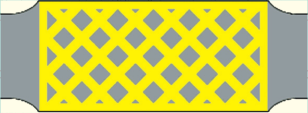
Box junction
Traffic must not enter unless they can clear the box junction without stopping, or when turning right.
You must not enter the yellow box junction unless you can clear it without stopping, or unless you are turning right and are prevented from doing so by oncoming traffic.

Broken white line
A driver must not cross the broken white line unless it is safe to do so.
A broken white line along the centre of the road means you must not cross the line unless it is safe to do so when overtaking or passing.
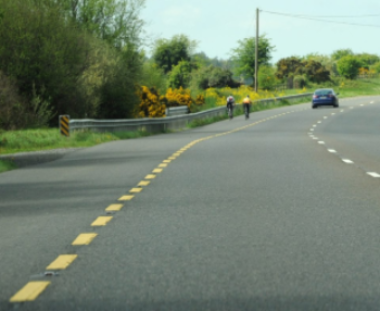
Broken yellow line
The edge of the carriageway or hard shoulder.
A single broken yellow line along the side of the road marks the edge of the carriageway/hard shoulder. This is normally for the use of pedestrians and cyclists. As a driver, however, you may use it briefly to allow faster traffic to overtake, but only where it is safe to do so.

Continuous white line
Drivers must keep to the left of the continuous white line.
A single continuous white line along the centre of the road means all traffic must keep to the left of the line. You are not permitted to overtake or perform a U-turn on this section of road.

Do not cross a continuous white line
Vehicles may not cross or drive over the line.
You must not cross or straddle a continuous white line in the centre of the road unless you wish to enter land or premises and it is safe to do so.

Double broken white lines
Continuous white lines ahead.
Double broken white lines along the centre of the road alert you to continuous white lines ahead. Do not cross them unless it is safe to do so.
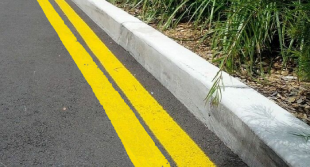
Double yellow lines
Parking prohibited at all times.
A double yellow line along the edge of the road means parking is not allowed at any time.

Keep left of the white line
All traffic must keep to the left of the white line.
Where there is a continuous white line in the centre of the road, you are not permitted to: 1. Straddle or cross the white line; 2. Overtake another vehicle; 3. Perform a U-turn; or 4. Park on the road.
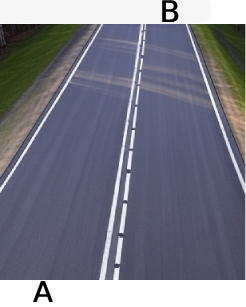
No overtaking across the lines
A driver may not cross the lines to overtake.
Where there is a broken white line and a continuous white line along the centre of the road, you must obey the line that is nearest to you. In this case, you may not cross the lines.
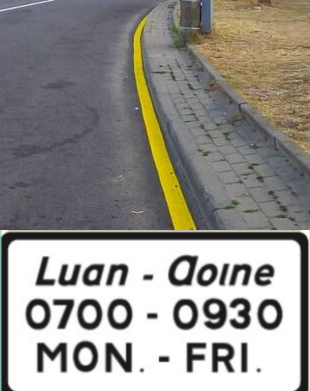
No parking at the times and days shown
Parking is not allowed at the times and days shown.
A single yellow line along the edge of a road means that you must not park there during the times shown on the accompanying information plate.
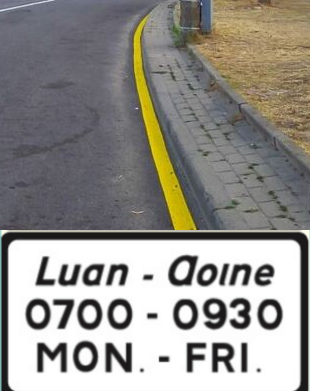
No parking at the times shown
Parking is not allowed at the times shown.
A single yellow line along the edge of a road means that you must not park there during the times shown on the accompanying information plate.
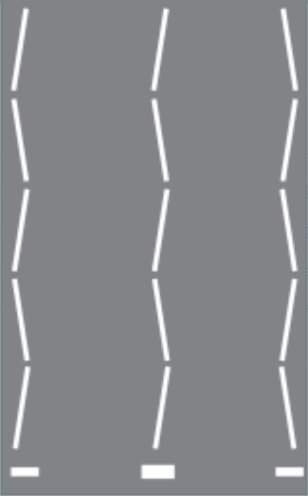
No parking in this area
White zigzag lines indicate that you are approaching a pedestrian crossing. You must not park or overtake within this area.

No U-turn over a continuous white line
No U-turn allowed.
You must never do a U-turn on any stretch of road with a continuous white line along its centre. The restricted vision at such places would make doing a U-turn very unsafe.
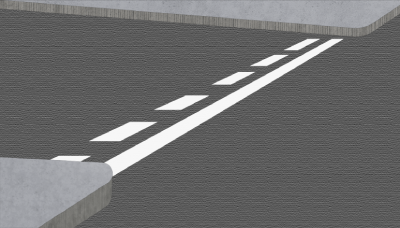
One-way street, no entry
No entry.
This road marking indicates a one-way street. You may not enter this street.
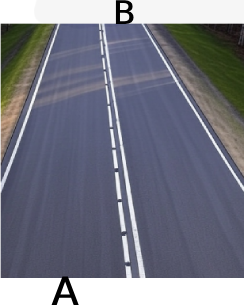
Overtaking allowed if safe
A driver may overtake if it is safe to do so.
Where there is a broken white line and a continuous white line along the centre of the road, you must obey the line that is nearest to you. In this case, you may cross the lines as long as it is safe to do so.
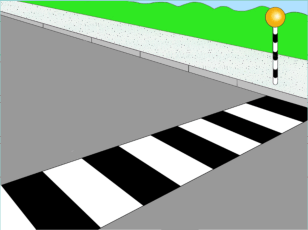
Zebra crossing
A zebra crossing is a designated area for pedestrians to cross the road. As a driver, you must always yield to pedestrians on a zebra crossing.
Now cover the meanings
The quiz shows you a sign and four options, exactly like the theory test does.
Take the road signs quiz